

The Old Testament books of 1 and 2 Samuel, 1 and 2 Kings, and 1 and 2 Chronicles record the rise and fall of the kings of Israel and Judah. These rulers shaped the spiritual and political direction of the Israelite people for centuries. Yet, their stories also reveal the deeper truth that no human king could ever fully embody the justice, holiness, and leadership of God Himself.
After the chaotic 400 year period of the Israelites found in the book of Judges, Israel was struggling with national disunity and repeated cycles of rebellion. The people demanded a king to lead them like the nations around them (1 Samuel 8).
Though this request was motivated by a desire for security, it was also a rejection of God’s kingship over them. Certainly, a God-fearing ruler could help point people in the right direction. But, external change doesn’t deal with the internal heart. People are not good at heart, they want to rebel. So asking for a king is kind of like putting a band-aid on a recently amputated part. It doesn’t address the issue. But, God often gave the people what they wanted, even if it meant rejecting Him.
Despite this, God allowed them to have a king—ushering in a new chapter in Israel’s history.
Saul was the first ruler and king appointed by God through the prophet Samuel (1 Samuel 9–10). Tall and impressive in appearance, Saul initially showed promise. However, his reign quickly unraveled due to pride, insecurity, and repeated acts of disobedience to God’s instructions.
One significant turning point came when Saul failed to follow God’s command regarding the Amalekites (1 Samuel 15). He turned away from God and as a result, God rejected Saul as king.
We then see a young shepherd boy named David, enter the picture and save the day (1 Samuel 17). Over time Saul and David would have a unique relationship.
Saul was so mentally weak he needed David to help him keep his emotions stable. At the same time, David rose to become the great military leader for Israel that Saul wasn’t and eventually became Saul’s successor. David was loved by the people of Israel.
Want to dig deeper? To learn more about Saul being appointed as king and what his reign looked like, read 1 Samuel 9-11 and 13-15.
David, Israel’s second king, is one of the most well-known figures in the Bible. He began his public life as a shepherd and rose to fame after defeating Goliath (1 Samuel 17). Unlike Saul, David demonstrated a heart aligned with God’s purposes. He unified the tribes of Israel, established Jerusalem as the capital, and led successful military campaigns.
David was also a prolific songwriter, responsible for half of the Psalms in the Old Testament. He also was a great warrior. When God told David to fight, or defend, he generally obeyed God. Because of that obedience, God blessed him, and the nation with victory! This, of course, made David a hero.
However, his life was not without serious failure. His sexual sin with Bathsheba and the arranged death of her husband, Uriah, marked a dark chapter in his reign (2 Samuel 11). He did nothing to bring justice when his own daughter was raped (2 Samuel 11-13). Despite his flaws, David’s genuine repentance and reliance on God preserved his legacy as “a man after God’s own heart” (1 Samuel 13:14; Acts 13:22).
Want to dig deeper? To learn more about David’s story, read when he was anointed as king in 1 Samuel 16, when he fought the Philistine giant, Goliath in 1 Samuel 17, and the growing tension between Saul and David in 1 Samuel 18-19.
Solomon, the son of David and Bathsheba, succeeded David as king. Known for his unmatched wisdom, Solomon made an early request for discernment in leadership, which pleased God (1 Kings 3). His reign was marked by peace, prosperity, and expansive building projects—including the construction of the First Temple in Jerusalem.
King Solomon asked for a “discerning heart to govern your people and to distinguish between right and wrong” (1 King 3:9), which helped him authored much of the biblical wisdom literature, including Proverbs, Ecclesiastes, and Song of Songs.
Despite his strong beginning, Solomon’s later years were marked by spiritual compromise. He accumulated great wealth, took hundreds of foreign wives, and began worshiping other gods, violating direct commands from the Law (Deuteronomy 17:16–20; 1 Kings 10–11). His unfaithfulness led to the decline of Israel’s spiritual integrity and set the stage for division.
Want to dig deeper? Because of the wisdom that King Solomon was given by God, he would go on to write additional books that passed along his insights – including the books of Proverbs, Ecclesiastes, and Songs of Songs. To get a taste of these book’s wisdom, read the following passages:
It took only 3 kings and 120 years before Israel’s descent into rampant sin. After Solomon’s death around 930 BC, two of his sons claimed the right to the throne, and they split the twelve tribes into two kingdoms – Israel and Judah:
This split resulted in two parallel lines of kings, recorded throughout the books of Kings and Chronicles. The Northern Kingdom of Israel, based in Samaria, never had a single king who followed God faithfully. The Southern Kingdom of Judah, based in Jerusalem, had a mixture of good and bad rulers.
Out of roughly 40 kings between Israel and Judah, only eight were described in Scripture as good or faithful to God. The rest either tolerated or promoted idolatry, injustice, and rebellion. The pattern shows that political leadership could never solve Israel’s deepest problem: a rebellious heart. The kings often reflected the spiritual state of the nation. When leaders turned from God, the people followed.
Here is a snapshot of the Kings of the Old Testament:
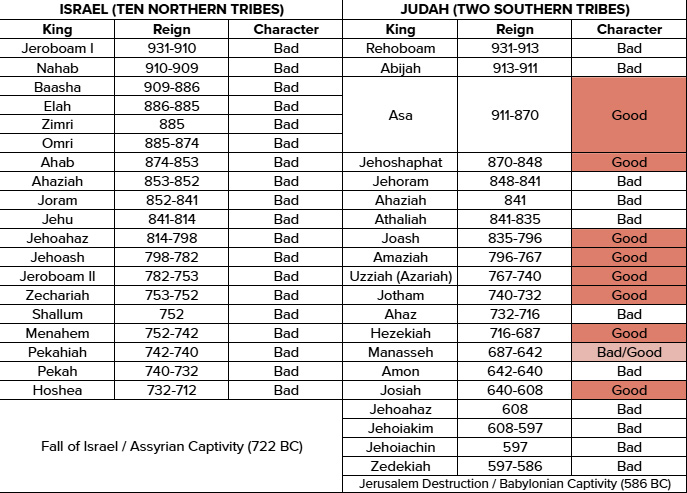
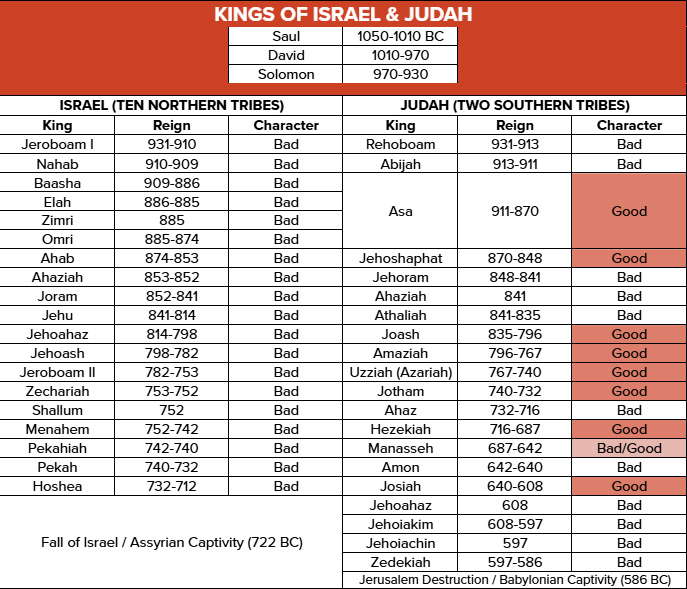
Want to dig deeper? To learn about the last good king in Judah, read 2 Chronicles 34-35 about King Josiah and how he began to seek God through the help of the woman prophet Huldah.
The era of the kings reveals the tension between human leadership and God’s authority. These rulers taught important lessons about obedience, repentance, and the consequences of turning away from God.
But more importantly, their failures pointed forward to the need for a better King—one who would lead not just with power, but with righteousness. The story of the Old Testament kings ultimately sets the stage for the arrival of Jesus Christ, the perfect King from the line of David, whose kingdom would never end.
Access the CHARA Bible Study Guide
Discover the Bible’s unified story from beginning to end
Connecting the Table of Contents to the Story of the Bible
How the Old Testament Sets the Stage for the Grand Finale of the New Testament