
“For I know the plans I have for you,” declares the Lord, “plans to prosper you and not to harm you, plans to give you hope and a future.” Jeremiah 29:11 (NIV)
Is God promising me that I will prosper and not experience harm?
IMMEDIATE: What is the theme or main idea found in the surrounding paragraph(s) (Jeremiah 29:1-14)?
The theme is restoration and hope to the Jews exiled in a foreign land.
BOOK: Is the theme from immediate context repeated throughout the book? How does the theme fit within the overall purpose of the book?
Hope is not the only theme, as Jeremiah also emphasized judgment against Judah for their unfaithfulness to God’s covenant.
WHO/WHEN: Who was it written to? When did the events take place? What was going on in history at that time?
Jews who were deported from Jerusalem to Babylon (597 BC).
WHY: Why was this message given to those people at that time?
To give them hope that God would bring them back to their land after 70 years in exile and to instruct them on how to live life in Babylon.
STYLE: What is communicated through the literary style the author used?
Prophecy & Letter. The prophet Jeremiah wrote a letter (29:1) revealing God’s heart for His people – God had a good plan for their future and had not abandoned them.
PATTERNS: What is highlighted through the use of repetition?
Plan, Plan, Plan (vs 11) – repetition emphasizes that God is in control–He had a plan and a purpose for His people even when it didn’t look like it.
OBSERVATIONS & QUESTIONS: What observations or questions do you have?
What does “prosper” mean?
TRANSLATIONS/ORIGINAL LANGUAGE: Does another Bible translation add perspective or clarity on what the original language was trying to communicate? What does a word mean in the original language?
Translation variations of the word “prosper”: Well-being (CSB), Good (NLT), Welfare (ESV), Peace (KJV). In Hebrew (šālôm): Wellfare, Peace (blueletterbible.org).
YIELD: What personal, cultural, or religious bias and assumptions do you bring to the text? What do you need to surrender, if anything, to be in harmony with the Bible?
I need to surrender my assumption that this is God’s promise to me, when it’s not. Because this verse is collectively for the Jews in exile, I may not personally prosper in my finances, family, or career and I may experience harm or suffering. To assume otherwise would not align with the rest of the Bible.
EXPRESS: What fears or concerns do you have about applying what you’ve learned?
I’m afraid that if I surrender to God’s plan and let go of control, I may lose the things I care about most and experience pain and suffering.
RESPOND/ASK: What was expected of the original audience and what principles make sense for us now (is it a cultural or timeless truth)? What do you learn about God – His character, attributes, or desires?
This is a cultural truth for the Jews in exile, but there is a timeless truth about God’s character – He is sovereign and we can trust and find hope in God’s faithfulness and purpose, even in difficult times.
PRAY: “Lord, what do you want me to learn and how should I apply this to my life?”
Lord, I praise you for your faithfulness. Help me to trust in your unchanging character and know your love when life hurts or doesn’t make sense.
“For I know the plans I have for you…”
“Don’t store up for yourselves treasures on earth…”
The Parable of the Shrewd Manager
The Emmaus Disciples
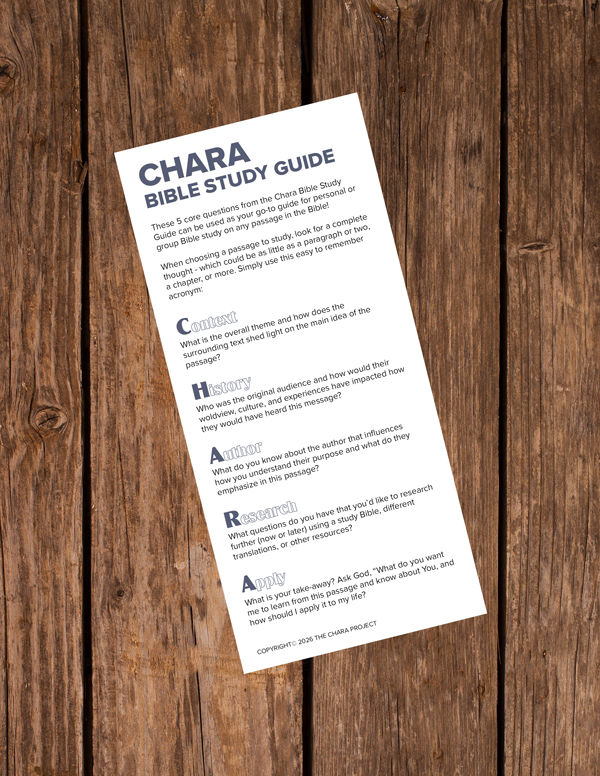
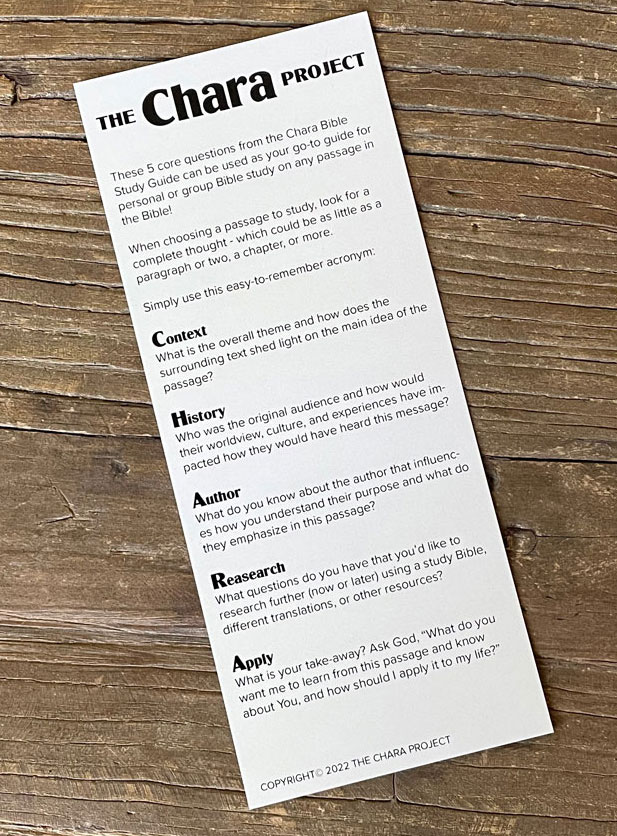
Use for any size passage – The CHARA Bible Study Guide can be used to study a single verse, passage, chapter or more!
It’s not a checklist – Not every question from this guide will apply to every passage. Pick out a handful of CHARA questions that will help unlock the original message and meaning. Just note the Key Principles to ensure Biblical accuracy.
Hop around – You don’t have to ask questions in the same order of C-H-A-R-A. Mix it up and go in any order that makes sense to guide you through the passage.
Here’s the best part – while using this guide in your Bible study, you’re simultaneously learning how to study the Bible. Before you know it, these questions will become second nature and if you’re like us, your confidence and desire to spend time in God’s Word will soar!
